
WordPress Website Design
Why Isn’t My Small Business Showing Up in ChatGPT or Google AI Search? (2026)

WordPress Website Design
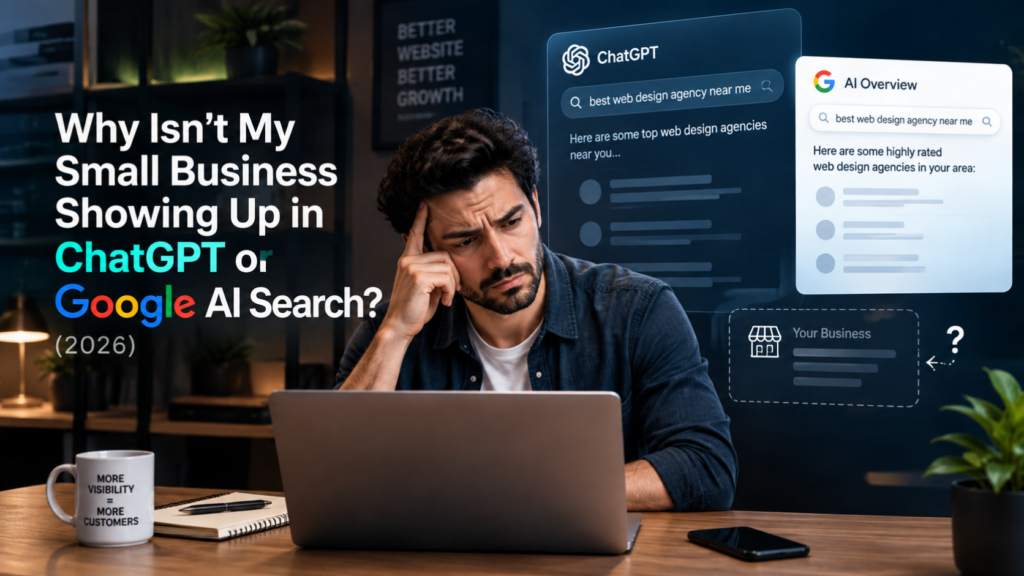
If you’ve searched your own business name in ChatGPT lately and gotten a vague answer, or worse, watched it recommend a competitor instead, you’re not imagining a decline. Why isn’t my small business showing up in ChatGPT or Google AI search is a question a growing number of American small business owners are asking right now, and the answer usually has nothing to do with how good the business actually is.
It has to do with whether AI tools can reach the website, read it cleanly, and trust what’s on it.
A recent report out of St. Petersburg, Florida found that AI tools are quietly filtering local businesses out of their answers based on website quality alone. According to St. Pete Catalyst, when someone asks ChatGPT, Perplexity, or Google’s AI Overviews where to find a local business, the answer increasingly comes from business websites directly, not Facebook pages or Yelp listings, and outdated or thin sites are being left out of the results entirely. The same report cites Pew Research Center data showing that 26% of search sessions now end after a user sees an AI-generated summary, up from 16% before AI Overviews existed. That distinction, being reachable, readable, and trustworthy rather than merely being online, is what the rest of this guide walks through.
Traditional Google search returns a list of links and lets the visitor decide what to click. AI search tools work differently. They read through multiple websites, pull out the specific facts and sentences that answer the question being asked, and generate one direct answer, often naming a single business or a short list.
That means a website doesn’t just need to exist. It needs to be reachable by the AI’s crawler, contain a clear answer to the question someone is likely to ask, and say the same basic facts everywhere the business is listed online. A homepage full of vague branding language with no specifics gives these tools nothing usable to pull from, even when every other condition is met. A plumber whose page states “24-hour emergency plumbing in Dallas, $89 dispatch fee” gives an AI tool something concrete to quote; a competitor’s page that just says “contact us for service” gives it nothing, regardless of how good either plumber actually is at the job.
This is the fastest check to run, and it catches a surprisingly common problem. Every AI company runs its own crawler bot that reads websites: OpenAI uses GPTBot and OAI-SearchBot, Anthropic uses ClaudeBot, and Perplexity runs its own as well. A site’s robots.txt file, found at yourdomain.com/robots.txt, can block any of these by name without the site owner ever noticing, especially on sites where a security plugin or hosting platform added a blanket rule automatically.
Open that file and look for a line reading “Disallow: /” sitting directly under any of those bot names. If it’s there, that specific AI tool cannot read a single page of the site, no matter how good the content is. This is worth checking even on a site that was built carefully, since some security plugins add these blocks by default during setup.
AI tools cross-check facts before they’ll confidently recommend a business. If the phone number, hours, address, or service list on the website doesn’t match what’s listed on the Google Business Profile or in directory listings, that inconsistency makes an AI system less willing to cite the business at all, since it can’t be sure which version is accurate. A phone number that changed two years ago but still appears in an old directory listing is exactly the kind of small, easy-to-miss mismatch that quietly costs a business its AI visibility.
This is a quick audit to run manually: pull up the website, the Google Business Profile, and any directory listings side by side, and check that the basics agree everywhere. A stale hour listed on one page or an old address still showing on a directory from years ago is a common, fixable cause of AI tools staying silent about a business that’s otherwise doing everything right.
Beyond crawler access and consistent facts, three content problems tend to knock a small business out of AI search results.
The content is too vague. Phrases like “quality service you can trust” or “serving customers since day one” don’t answer any real question, so AI tools have nothing concrete to quote from them.
The site is outdated. Old pricing, an expired promotion still showing, or a copyright year that hasn’t been updated in years signals to both Google and AI tools that the content might not be current or reliable.
The structure is a mess. If a page has no clear headings, no direct answers near the top, and buries useful information under paragraphs of filler, an AI tool has a harder time finding anything worth extracting. Any single one of these three problems can be enough to keep a site out of an AI-generated answer, even when the underlying business is genuinely excellent at what it does.
The businesses that do get cited by AI tools tend to share a few concrete traits, and all of them are things a website can control directly.
They answer the question early. A page about pricing states the actual price range near the top, not three paragraphs into a sales pitch.
They use real numbers and specifics. Ahrefs’ own study of 300,000 keywords found that once an AI Overview appears above the top organic Google result, that top result’s click-through rate drops by 58%, which means the businesses still getting clicks are the ones whose content gets pulled into that AI Overview in the first place, not just ranked below it.
They keep information current. A site updated within the past year reads as more trustworthy to both search engines and AI systems than one that hasn’t changed since it launched.
One thing worth being accurate about here, since it gets overstated a lot: structured data, also called schema markup, can help an AI system understand a page faster, but it’s a help, not a strict requirement. A clean, clearly written page without schema markup will still get read and quoted if the content itself is specific and well organized. Skip a redesign chasing schema markup alone if the underlying content is still vague.
The difference between a site AI search tools skip and one they cite usually comes down to access, accuracy, and structure, not marketing spend.
Start with the robots.txt check above; it takes two minutes and rules out the simplest possible cause. Then work through the business information audit, since a mismatch there quietly undermines everything else on the list.
From there, move to the pages that answer the questions your actual customers ask before they hire someone: pricing, service areas, what’s included, how long a project takes. Rewrite the vague sentences into direct answers. State the real price range instead of “contact us for a quote.” Name the actual service area instead of “serving the region.”
Update anything stale. A footer copyright year stuck two years in the past, an old phone number, or pricing that no longer matches what’s actually charged all signal the same thing to an AI tool: this page might not be current, skip it.
Then look at the structure itself. Clear headings that state exactly what each section covers make it far easier for an AI system, and a human skimming on their phone, to find the specific answer they need. This is exactly the difference between a templated site thrown together quickly and one built with real information architecture, like the approach covered in our breakdown of what a properly built WordPress site actually costs.
An AI tool can’t recommend a business it can’t reach, can’t verify, or can’t understand. If a website makes any one of those three things hard, an AI system will just move on to a site that doesn’t.
If your current site was built quickly on a generic template with placeholder-style copy still in place, this is usually where the problem actually lives. See our WordPress website design service for what a properly structured rebuild looks like.
Usually one of three things: an AI crawler is blocked in your robots.txt file, your business information doesn’t match consistently across your website and listings, or your site simply doesn’t contain a clear, specific answer to the question being asked. Check the crawler block first, since it’s the fastest thing to rule out.
Not necessarily. AI tools often cite pages that answer a specific question well, even if that page isn’t the top-ranked Google result for a broad search term. Specific, well-structured answers to narrow questions can get cited even from a lower-ranking page.
Regular Google search shows a list of links for the visitor to choose from. AI search tools read multiple sites, extract the specific facts that answer the question, and generate one direct answer, often naming a specific business rather than just linking to it.
It helps, but it isn’t strictly required. A clean, clearly written page without schema markup can still get read and cited if the content itself is specific and well organized. Adding schema markup is a worthwhile improvement, but it won’t fix a page whose actual content is still vague.
Often, yes, for smaller issues. Checking robots.txt, correcting mismatched business information, and rewriting vague sections into direct answers can all be done without a rebuild. If the underlying site structure itself is the problem, a rebuild becomes worth considering.
There’s no fixed timeline, since it depends on how often AI tools and search engines recrawl the site and how competitive the specific question is. Clearing a crawler block or fixing mismatched information can show results within weeks; broader visibility from content improvements usually builds over a few months, similar to normal SEO timelines.
They can factor in, since AI tools also look for outside mentions of a business, not just the website itself. But AI search tools have shown a strong preference for pulling directly from business websites when a website has clear, current, consistent information. A strong review profile helps; it doesn’t replace the need for the website itself to answer questions clearly.
See our WordPress website packages — pricing, what's included, and how the process works.

Founder of Judesk Tech, building WordPress websites, brands, and marketing for small businesses across the USA.

AI website builders promise a fast site for any small business. Here's where that falls short specifically for…

45% of US consumers now use AI tools to find local businesses, up from 6% last year. What…

Real 2026 WordPress pricing tiers for small businesses, what actually drives the cost, and what's not included in…
Ready to start?
Spotted something broken? Let us know and we'll take a look.
Join the discussion
No comments yet. Be the first to share your thoughts.