
WordPress Website Design
AI Overviews and ChatGPT Are Changing How USA Small Businesses Get Found Online (2026)

WordPress Website Design
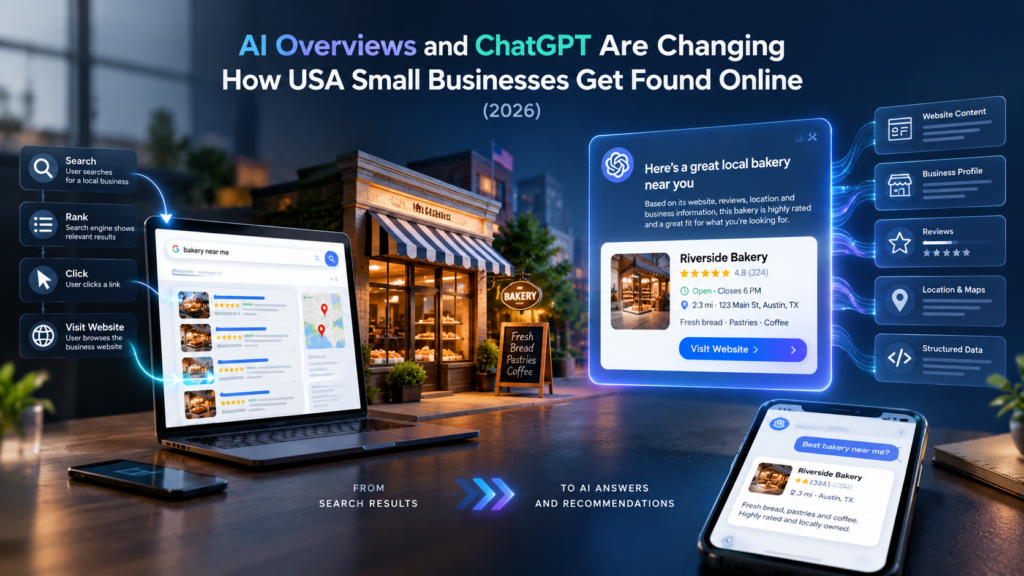
A year ago, getting found online mostly meant ranking on Google. In 2026, a growing share of the people looking for a plumber, a bakery, or a WordPress agency in the USA never see a ranked list of links at all. They see an AI-generated answer, or they ask ChatGPT directly and never open Google. This is what people mean when they say AI Overviews and ChatGPT are changing how USA small businesses get found online: search doesn’t end at a click anymore.
This shift in how small businesses in the USA get found online is not a future trend to watch. It has already happened, it’s measurable, and most small business websites were built for a version of search that no longer works the way it used to.
According to BrightLocal’s 2026 Local Consumer Review Survey, 45% of US consumers have used an AI tool like ChatGPT, Gemini, or Perplexity to find a local business in the past year, up from just 6% the year before. AI is now the third most-used source for local business recommendations in the USA, behind only Google and Facebook, and ahead of Yelp.
The short version: nearly half of US consumers now use AI tools to find local businesses, and those tools read a website’s structure and data differently than Google’s classic ranking system did. A site built the old way can rank fine and still be invisible to the AI tools an increasing number of customers are actually using.
This isn’t one survey in isolation. Multiple independent studies point the same direction. Ahrefs’ December 2025 analysis of 300,000 keywords found that when a Google AI Overview appears above the results, the top-ranking page’s click-through rate drops by 58%, up from a 34.5% drop measured less than a year earlier. Fewer people are clicking through to websites even when a business ranks first, because the answer is often already sitting above the results.
| What changed | 2025 | 2026 |
|---|---|---|
| US consumers using AI to find local businesses | 6% | 45% |
| CTR drop on the #1 result when an AI Overview appears | 34.5% | 58% |
| Google’s share of local business discovery | 83% | 71% |
Traditional Google ranking still exists, but it now sits underneath a layer of AI that decides what to summarize and who to recommend before a person ever scrolls to the blue links. Google’s AI Overviews, Google’s AI Mode, and outside tools like ChatGPT and Perplexity pull from a business’s website content, its Google Business Profile, and its reviews to generate an answer directly on the page.
That means the question has shifted from “does my site rank” to “does the AI have a clear, accurate, well-structured picture of my business to recommend from.” A business can still rank on page one and be skipped entirely if the AI can’t confidently pull a clean answer out of the page.
Search used to end at a click. In 2026, it often ends at an AI-generated answer instead.
Most small business sites in the USA were built for the old model: a homepage, a few service pages, and a design meant to look good to a human visitor who clicks through and reads. That’s still necessary, but it’s no longer sufficient. Structured data (schema markup) telling machines exactly what a business is, what it does, and where it operates is often missing entirely. Service information is frequently buried in a single crowded page instead of broken into clear, specific sections an AI system can lift cleanly.
The businesses showing up in AI answers aren’t the flashiest ones. They’re the ones whose sites make it obvious, in plain structured terms, exactly what they do and where.
The fixes are concrete, not speculative. A dedicated page per service, rather than one page trying to cover everything, gives an AI system a clean, specific answer to lift. LocalBusiness schema markup makes a business’s name, address, phone number, hours, and service area machine-readable instead of buried in design. Fast load times still matter, both for visitors and for how reliably a page gets crawled and cited. And consistency between the website, the Google Business Profile, and reviews builds the kind of confidence these systems look for before naming a business by name.
This is the same underlying principle behind the page-per-service structure we’ve written about for other niches, including CRM Website vs. WordPress: Which Is Right for Contractors?, just with a new, more urgent reason behind it. It also raises the stakes on site speed, which we broke down in detail in Why Is My WordPress Website So Slow?
If your website is a single-page template, has no structured data, or hasn’t been touched since it launched, this is the moment that gap starts costing real visibility, not just a cosmetic problem. The businesses gaining ground right now aren’t necessarily the biggest names in their market, they’re the ones whose sites are simplest for an AI system to read accurately.
This matters differently depending on what kind of business you run. A home services company competing for “best plumber near me” style questions is now competing to be named inside an AI answer, not just to rank. A retailer or e-commerce store is competing to have its product and service pages clear enough that an AI tool can describe them accurately instead of guessing. In both cases, the fix starts in the same place: a website built with real structure behind it, not a generic template with a business name swapped in.
Not necessarily. Many sites need structural fixes, schema markup, and clearer service pages rather than a full rebuild. A site audit is the right first step before assuming a full rebuild is required.
Schema markup is structured code added to a webpage that tells search engines and AI systems exactly what a business is, what it offers, and where it’s located. It’s a format machines can read directly instead of inferring meaning from design and layout, which is exactly what these newer AI tools rely on.
It matters more for small businesses in some ways, since AI tools are actively surfacing local recommendations users didn’t previously get from Google’s classic results, and a small business with a clean, well-structured site can compete for that visibility without outspending a national brand.
It can reduce clicks on informational searches specifically, since fewer people scroll past an AI-generated answer. Being named inside that answer, rather than being skipped entirely, is what determines whether the reduced click volume still reaches your business.
AI tools reference reviews when generating local recommendations, and businesses with little or no review presence are far less likely to be surfaced at all, regardless of how well-built the website is. A steady stream of recent reviews signals to these systems that a business is active and worth recommending.
No, but WordPress gives full control over the exact things this requires: schema markup, clean URL and heading structure, and dedicated service pages. That control is much harder to get on a locked-down template or website builder.
Google’s Rich Results Test and Search Console’s Enhancements reports will show whether structured data is present and valid on a given page, without needing to read the site’s code directly.
If your site is missing the structure this requires, that’s a WordPress build issue, not a content or ads issue. See our WordPress website design services for what a properly structured rebuild involves.
See our WordPress website packages — pricing, what's included, and how the process works.

Founder of Judesk Tech, building WordPress websites, brands, and marketing for small businesses across the USA.
AI website builders promise a fast site for any small business. Here's where that falls short specifically for…

Why AI tools like ChatGPT and Google AI Overviews skip over small business websites, and what actually makes…

Real 2026 WordPress pricing tiers for small businesses, what actually drives the cost, and what's not included in…
Ready to start?
Spotted something broken? Let us know and we'll take a look.