
WordPress Website Design
AI Website Builder vs. WordPress: Which Is Right for Your Small Business? (2026)

WordPress Website Design
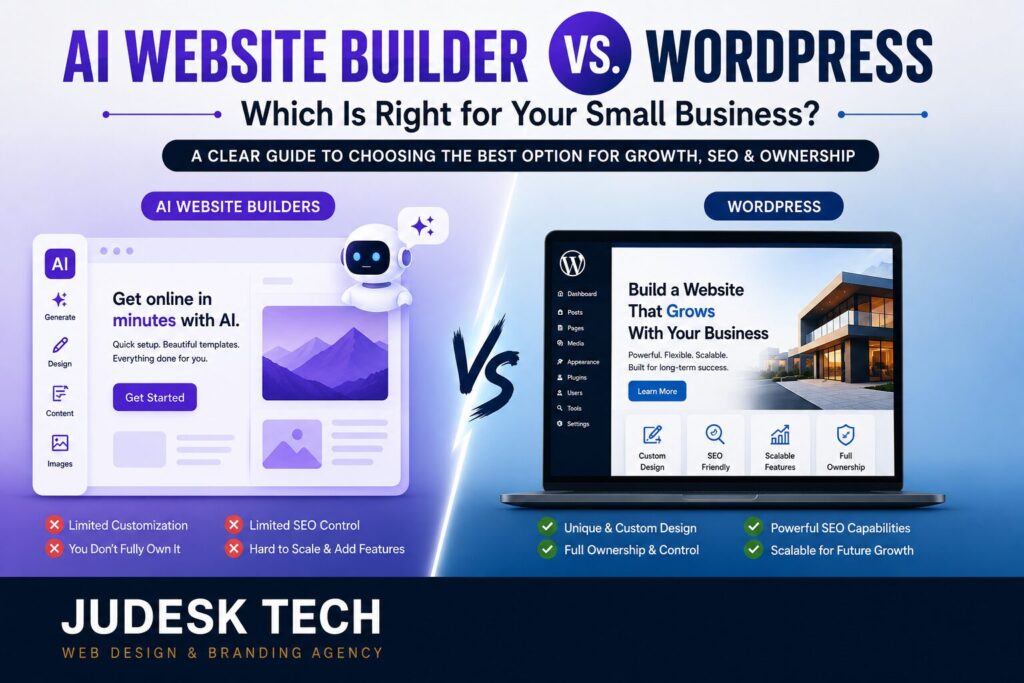
If you’ve looked into building a website for your small business recently, there’s a good chance an AI website builder came up in the conversation. Wix ADI, Squarespace’s Blueprint AI, Hostinger’s AI builder, and a growing list of similar tools now promise a finished, professional-looking website in minutes, no designer or developer required.
So is that enough, or should you still build a real site on WordPress? The honest answer depends on what the website needs to do for your business, and most small business owners have never had someone walk them through that tradeoff in plain terms. That’s what this article does, not a sales pitch for one option over the other, just a clear look at what each one is built for, where the AI option genuinely holds up, and where it quietly starts costing you customers.
It helps to understand what these tools are built to solve. AI website builders exist to remove the two biggest barriers to getting online: design skill and technical setup. Describe your business in a sentence or two, and the platform generates a complete homepage, service pages, and a contact form, styled and written for you in a matter of minutes.
That’s a genuinely useful thing to exist. A business that never had a website at all, and needed one yesterday, now has a real option that didn’t exist ten years ago. The tools aren’t a gimmick. They solve a real problem for a specific kind of business at a specific stage.
The tradeoff is what they’re optimized for. Platforms like Wix, Squarespace, and Hostinger are built to get you from zero to published as fast as possible, on their platform, inside their ecosystem. Getting you online quickly is the product. Getting you ranking, converting, and scaling past a handful of pages was never the primary design goal.
WordPress currently powers roughly 42% of all websites, according to W3Techs’ ongoing CMS usage tracking, by far the largest share of any single platform. That scale is exactly why an entire ecosystem of developers, plugins, and specialized tools exists around it, giving a WordPress site a depth of control an AI builder’s closed platform simply can’t match. That gap is what the rest of this article walks through.
Under the hood, an AI website builder generates a template, just a much smarter one than the drag-and-drop kits from a decade ago. You answer a few questions or describe your business, the AI selects a layout, writes placeholder copy, and picks stock images that roughly match your industry. Some platforms let you regenerate sections you don’t like or swap the color scheme. Very few let you touch the underlying code or move the site anywhere else.
That last point matters more than it seems at first. The site lives on the platform’s infrastructure, using the platform’s templates, subject to the platform’s pricing and rules. You’re renting a good-looking storefront in someone else’s mall, not building your own building.
The short version: an AI website builder is a fast, capable way to get a professional-looking site online, not a long-term platform built to compete for search traffic or grow with a business past its first year or two. Understanding that distinction is most of what you need to decide whether it’s still doing its job for you.
AI builders draw from a finite library of layouts and design patterns, trained to produce results that look polished and safe, not distinctive. Two competitors in the same city, using the same platform, often end up with sites that share a structural DNA even when the colors and photos differ. A customer comparing a few options online has a harder time telling one business apart from the next, and when the presentation feels interchangeable, price becomes the deciding factor.
Cancel the subscription, hit a plan limit, or decide to move to a different platform, and the site as built usually can’t come with you. Most AI builders don’t export clean, portable code. What looks like your website is really a configuration sitting inside someone else’s system, and if that system changes its pricing, its terms, or drops a feature you depend on, there’s very little you can do about it.
AI builders handle the SEO basics well: titles, meta descriptions, a sitemap, reasonably clean markup. Where they run into a wall is anything more specific, like a dedicated page targeting one city or one service, custom schema markup for a particular kind of business, or fine control over page speed and code weight. That’s exactly the layer where local search rankings are won.
The three most common signs an AI-built website is starting to hold a growing business back.
Need a real booking system tied to your specific workflow, a members area, a searchable catalog with hundreds of items, or an integration with software you already run the business on? Most AI builders can approximate simple versions of these through a native app or a marketplace plugin, but anything specific to how your business operates usually needs custom development, which is exactly what these platforms aren’t built for.
A custom WordPress build starts from your actual business, your actual photos, your actual services, instead of a generated layout trying to describe a generic version of your industry. If your best-converting offer needs to be front and center on the homepage, a real build lets you put it there. A template generated in thirty seconds was never designed around that specific decision.
It’s a sentiment a lot of small business owners land on after a few months on an AI builder: the site doesn’t need to look more advanced, it needs to look like nobody else’s.
WordPress’s scale, and the ecosystem built around it, means full control over the things that actually affect search rankings: page titles, meta descriptions, service-specific pages per topic or city, schema markup, image handling, and site speed, none of it locked behind a platform’s limits.
A dedicated page for one specific service in one specific area will almost always outrank a single AI-generated page trying to summarize everything a business does. That kind of long-tail page structure is exactly what a WordPress build is suited to produce, and exactly what most AI builders aren’t designed to scale into.
A WordPress site isn’t locked to one vendor’s app marketplace. Need a genuine booking system, a members area, a custom quote calculator, or an integration with the software already running the business? There’s very likely a plugin built for it, and if there isn’t, it can be custom built, because the underlying code is open and fully yours to extend.
The files, the database, and the design all belong to the business, not to a platform account. Move hosts, change developers, or grow far past where things started, and none of that history disappears. What gets built stays built.
The point where an AI-built site typically stops being enough for a growing small business.
| What matters | AI website builder | A real WordPress site |
|---|---|---|
| Ownership | Tied to the platform account | Yours outright, forever |
| Design | Generated from a template library | Built around your business |
| SEO control | Basics only | Full control |
| Location or service pages | Usually one general page | One page per service, per area |
| Adding custom features | Limited to the platform’s app marketplace | Virtually unlimited |
| If you cancel or switch | Site typically can’t move with you | Nothing changes |
| Speed to launch | Minutes to a day | A real build, days to a few weeks |
| Ongoing cost | Monthly subscription, indefinitely | One build cost, hosting after that |
To be fair to the AI option: if the business is brand new, testing an idea, or not yet actively trying to grow through Google search, an AI-built site can genuinely do the job for a while. There’s no reason to spend more solving a problem that doesn’t exist yet. Plenty of small businesses run for a year or two on word of mouth and a simple AI-built page that just confirms the business is real, and for them, that’s exactly the job the site needs to do.
The AI builder stops being enough the moment search traffic matters for getting customers, or the moment a competitor with a real site starts consistently outranking the business in its own market. That’s usually the point where the math flips: what used to be a reasonable shortcut starts quietly costing the business customers every month it stays in place.
It’s worth being concrete about what “quietly costing customers” means in practice. If an AI-built site can’t rank for a specific service in a specific city because the one page trying to cover everything is competing against dedicated pages from real competitors, every one of those searches goes to whoever shows up on page one.
It shows up in conversion too, not just visibility. A visitor who lands on a site that reads like a template has less reason to trust one business over the next beyond price. A site built around real, specific proof of the work gives them an actual reason to choose one business over another, which is the difference between winning on value instead of racing to the bottom on price.
See our WordPress website packages for pricing and what’s included.
Not if it’s done correctly. Proper redirects from every old URL to its matching new page preserve almost all of the SEO value already built, and rankings typically recover within a few weeks, often improving once the new site’s structure kicks in.
The design and layout usually can’t transfer directly, since most AI builders don’t export portable code, but the content, photos, and copy that are already working can absolutely be brought over and rebuilt properly on WordPress.
It depends on scope, but a focused build, homepage, core pages, and a contact form, can go live within a couple of weeks once content and photos are ready.
Day to day, not really. Updates and basic maintenance are simple once the site is set up correctly, and most small businesses work with a developer or agency for anything beyond routine content changes, the same way they’d rely on support from an AI builder’s platform.
An AI builder is typically a smaller monthly fee that continues indefinitely. A WordPress site usually involves a larger upfront build cost followed by modest ongoing hosting, which often works out cheaper over a few years and comes with an asset the business actually owns.
Yes, especially early on or in a market with little competition. The limits show up as the business grows and needs more specific pages, more technical SEO control, or wants to outrank competitors who have already made the switch.
Generally once search traffic starts to matter for getting customers, once a competitor with a real site starts consistently outranking the business, or once the business needs functionality the AI builder’s marketplace can’t provide.
No. The domain belongs to the business regardless of which platform the website runs on. The new WordPress site can go live on the exact same domain the business already uses.
No. The day-to-day experience, writing posts, updating pages, adding images, is done through a visual editor, similar to what an AI builder offers. Coding only comes into play for custom development work, which a developer or agency typically handles.
Yes. AI content and image tools aren’t exclusive to AI website builders. Many WordPress sites use AI assistance for writing, image generation, and SEO research while running on a platform built for long-term growth.
See our WordPress website packages — pricing, what's included, and how the process works.

Founder of Judesk Tech, building WordPress websites, brands, and marketing for small businesses across the USA.
AI website builders promise a fast site for any small business. Here's where that falls short specifically for…

Why AI tools like ChatGPT and Google AI Overviews skip over small business websites, and what actually makes…

45% of US consumers now use AI tools to find local businesses, up from 6% last year. What…
Ready to start?
Spotted something broken? Let us know and we'll take a look.
1 Comment
I love the content.
Comments are closed on this post.