
WordPress vs. Shopify for Supplement Brands in the USA (2026)

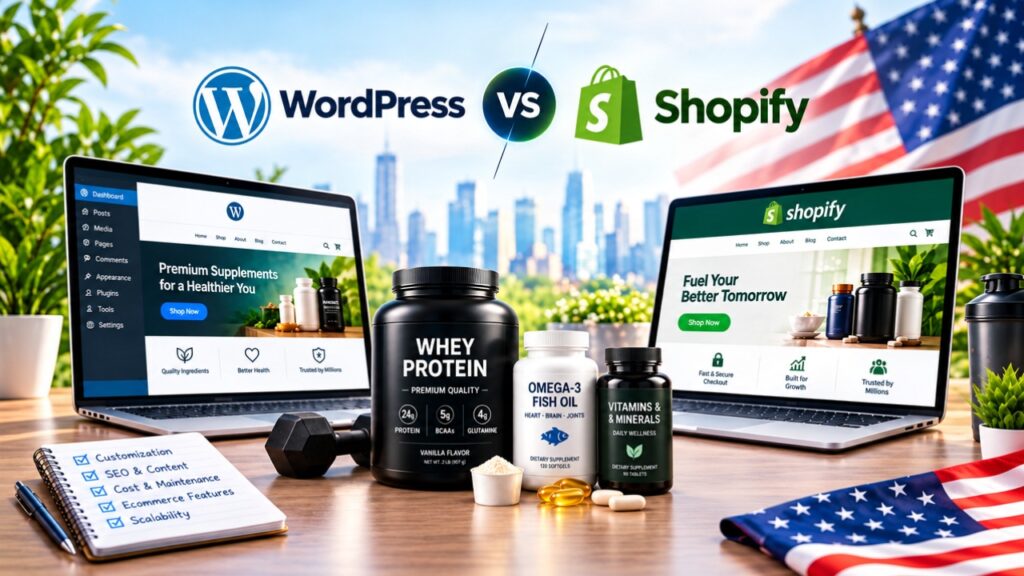
If you sell supplements or nutrition products online and you’re choosing between Shopify and a custom WordPress build, the honest answer is that both can run a real store. The question that actually matters for a US supplement brand comparing WordPress vs Shopify is which one you still want to be running in three years, once your catalog, your promotions, and your margins have all gotten more complicated than they are today.
We built a custom WordPress commerce platform for Supplement World, a US nutrition retailer, migrating their full 201-product catalog off a locked-in hosted platform. This post walks through what that tradeoff actually looks like in practice, not the generic “it depends” version.
In a September 2024 survey of 150 e-commerce managers, conducted by commercetools and reported by Digital Commerce 360, 56% of respondents named total cost of ownership as a top factor in judging their platform, and 86% of those who migrated reported a meaningful increase in customization options afterward. commercetools sells a composable commerce platform, so a survey from them leans toward favoring flexible, less locked-in setups, and that bias is worth naming. Even accounting for it, the pattern matches what a supplement brand runs into: a hosted platform’s app fees and template limits cost more, in money and in flexibility, as a catalog grows past a few dozen SKUs.
The short version: Shopify gets a supplement store online fast, with app-store add-ons for most of what a small catalog needs, but monthly plan costs, transaction fees, and app subscriptions stack up as the catalog and promotions get more complex, and the store’s data and logic stay inside Shopify’s system. A custom WordPress build costs more upfront and takes longer to launch, but the brand owns the code, the data, and the checkout logic outright, with no per-app monthly fees layered on top. We moved Supplement World’s full 201-product catalog onto a custom WordPress build with no recurring platform or app fees beyond hosting and payment processing.
Shopify’s advantage is speed and a mature app ecosystem. A supplement brand can be selling within days, with inventory, subscriptions, and reviews handled by existing apps rather than custom code. The cost shows up over time: Shopify’s plans run from roughly $39 to $399 a month before apps, most useful commerce apps (subscriptions, advanced reviews, loyalty, upsells) carry their own monthly fee on top of that, and the store’s product data, customer records, and checkout flow all live inside Shopify’s platform rather than in code the brand controls.
Custom WordPress commerce flips that. There’s no monthly platform fee and no per-app subscription stack, since the features a supplement brand actually needs (reviews, order management, customer accounts) get built directly into the site’s own code instead of rented from an app store. The tradeoff is real: it takes a real development project to get there, not a weekend setup. It’s the right call for a brand that expects to still be selling in three years and wants the catalog, the reviews, and the checkout logic to belong to them rather than to a platform they’re renting space from.
Supplement World didn’t migrate off Shopify. Their store was built on BigCommerce, another hosted, locked-in platform in the same category as Shopify, and they moved to a fully custom WordPress build. We’re naming that difference directly rather than letting the case study imply something it isn’t. BigCommerce and Shopify solve the same problem the same way: both host your store, your data, and your checkout logic on their own infrastructure, and both charge ongoing fees for the apps that make a growing catalog work. A brand with a 201-product catalog, Supplement World’s actual size when it migrated, hits that ceiling on either platform at roughly the same point, which is why a brand choosing between Shopify and WordPress today is weighing the same tradeoff Supplement World weighed between BigCommerce and WordPress.
Supplement World came to us running a 201-product active catalog on BigCommerce, with another roughly 240 products that had been intentionally hidden rather than sold. We built a custom WordPress commerce platform from scratch: a dedicated commerce plugin handling the catalog, orders, and customer accounts, paired with a custom storefront theme built around the brand’s own black, orange, and off-white design system. Payments run through Authorize.net. Product reviews were rebuilt as a native feature, seeded with the store’s real historical reviews from BigCommerce rather than starting from zero, with public submission, spam protection, and admin moderation built directly into the site.
On the SEO side, migrating off a hosted platform meant handling the redirect work a platform switch normally breaks: a 480-rule redirect map covering every old BigCommerce URL, plus a real XML sitemap kept current as the catalog changes. None of that is unique to BigCommerce. Any store migrating off any hosted platform, Shopify included, runs into the same redirect and sitemap problem, and it’s exactly the kind of work that gets missed when a migration is rushed.
A hosted platform will sell your product today. The question is who owns the store once you’ve outgrown the plan you started on.
The real tradeoff: Shopify’s speed and app ecosystem versus a custom WordPress build’s ownership and lower long-term cost.
| Factor | Shopify | Custom WordPress |
|---|---|---|
| Monthly cost | $39-$399 plan, plus per-app fees | Hosting and payment processing only, no platform fee |
| Launch timeline | Days to a few weeks | A real development project, typically weeks to months depending on catalog size |
| Data and checkout ownership | Lives on Shopify’s platform | Owned outright by the brand |
| Customization ceiling | Limited by theme and app capabilities | Limited only by what gets built |
| Best fit | A brand testing a new product line fast | An established catalog planning to grow for years |
Qualitative cost comparisons are easy to wave off, so here’s an actual worked number. The figures below are estimates built for this example, not Supplement World’s real invoice, which we don’t disclose. They’re based on typical published Shopify plan and app pricing and typical custom WordPress build costs for a 200+ SKU supplement brand running subscriptions, product reviews, and basic upsell/cross-sell offers, the same feature set Supplement World uses.
Over three years, a Shopify mid-tier plan built for a growing catalog runs roughly $105 a month. A subscriptions app adds about $29 a month, a reviews app with moderation adds about $35 a month, and an upsell/cross-sell app adds about $29 a month, for a combined estimate near $198 a month. Over 36 months, that’s approximately $7,100, and that number tends to climb, not stay flat, as a catalog grows and more apps get added.
Custom WordPress costs differently. A one-time build for a 200+ SKU commerce site with the same feature set, reviews, order management, and customer accounts built in rather than rented, typically runs somewhere in the $10,000-$16,000 range depending on scope. Add hosting at roughly $50 a month, and the 3-year estimate lands near $14,800.
Here’s the math: in this estimate, Shopify is actually cheaper through year three, roughly $7,100 versus $14,800. The custom WordPress build only pulls ahead once you look past the payback period, because its $50/month hosting cost stays flat while Shopify’s roughly $198/month tends to grow as more apps and higher-volume plan tiers get added. A brand expecting to still be running the same catalog in five to eight years crosses over into the WordPress build being the cheaper option. A brand testing a smaller catalog, or one that might pivot in a year or two, is better served by Shopify’s lower upfront cost, which is exactly why Shopify remains the right call for a brand just getting started.
A supplement brand launching a first product or testing a new line fast is usually better served by Shopify. The app ecosystem covers subscriptions, reviews, and basic SEO out of the box, and the monthly cost is predictable while the catalog is still small. Supplement World wasn’t in that position. A 201-product catalog with an established customer base and real BigCommerce order history is exactly the case where a custom build pays off: the migration cost is a one-time project, not a monthly bill that compounds as more apps get added.
The honest middle case is a brand that’s grown past a handful of products but isn’t sure it’s ready to commit to a custom build. In that situation, it’s worth totaling up the current monthly spend across the platform plan and every app subscription, since that number is usually higher than it looks when it’s spread across several small charges instead of one line item.
Over time, usually yes for a US-based brand, once a catalog is large enough to need several paid apps on Shopify. There’s no Shopify-style monthly platform fee on a custom WordPress build, only hosting and payment processing, though the upfront development cost is higher than Shopify’s near-instant setup.
Yes, but it has to be built in rather than installed from an app store. Supplement World’s reviews, order management, and customer account features were all built directly into the site’s own commerce plugin rather than rented as separate app subscriptions.
It depends mainly on catalog size and how much custom functionality is needed. Supplement World’s 201-product migration, including a 480-rule redirect map and a rebuilt review system, was a multi-month project, not a weekend task.
Rankings are at risk if old URLs aren’t redirected correctly. Supplement World’s migration included a full redirect map covering every old BigCommerce URL and a current XML sitemap, which is the same work any Shopify-to-WordPress migration needs to protect existing search rankings.
Yes. Hosting and a payment gateway (Supplement World uses Authorize.net) are separate costs from the build itself, but they replace Shopify’s bundled hosting and payments rather than adding a new expense on top of one.
Yes, for a brand launching fast with a small catalog that doesn’t yet justify a custom build. The tradeoff shifts toward WordPress as the catalog, the customization needs, and the number of paid apps all grow.
Because Shopify and BigCommerce solve the same problem the same way: both are hosted platforms that charge ongoing fees and keep a store’s data on their own infrastructure. Supplement World’s real migration off BigCommerce answers the same cost-and-ownership question a Shopify comparison would.
See our WordPress Website Design service for what a custom e-commerce build actually involves, or read how we handled a B2B wholesale supplement distributor’s WooCommerce build for a different kind of supplement business.
See our WordPress website packages — pricing, what's included, and how the process works.

Founder of Judesk Tech, building WordPress websites, brands, and marketing for small businesses across the USA.

A WordPress website for a painting company in the USA runs $499 to $2,499, depending on photo galleries,…

A WordPress website for a snow removal and landscaping company in the USA runs $499 to $2,499, depending…

Real 2026 WordPress pricing for limo companies in the USA: $499 to $2,499, what each tier includes, and…
Spotted something broken? Let us know and we'll take a look.